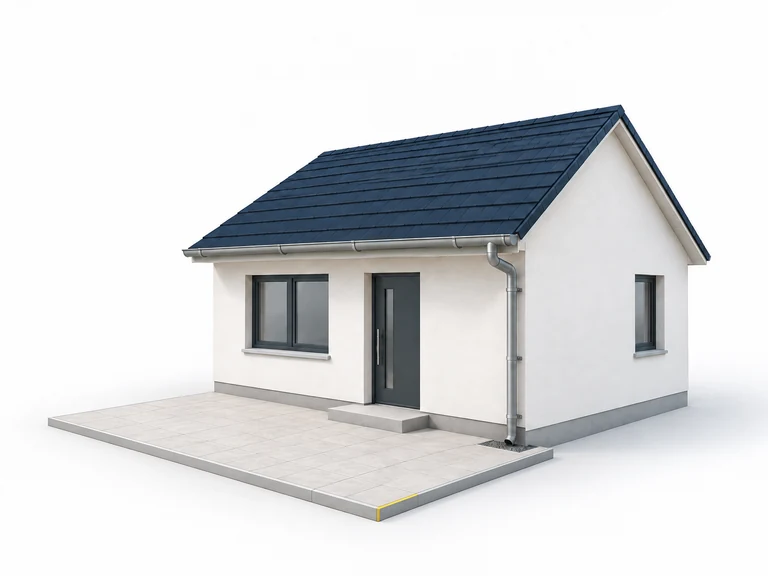
Choose a pricing basis without hiding the time assumption.
Per-area pricing starts from a measured surface and a price per square metre or square foot. A time-led comparison starts from your estimated elapsed job time and included costs. These are different ways to examine the same scenario.
Neither method tells you how quickly a particular surface can be cleaned. Enter a time based on your own assessment or label it as an estimate; this guide supplies no universal output-per-hour figure.
Measure only the surface in the cleaning scope.
For a rectangular patio, multiply length by width. If the outlined area includes an uncleaned bed or another excluded section, account for it before entering the cleaned dimensions.
Use the driveway tool for a supported widening main section plus a separate apron. This guide uses a patio so that its area/time comparison does not duplicate the driveway measurement job.
Convert the rate together with the area.
A 10m × 6m patio is 60m². Using the exact international-foot factor, that is approximately 645.835ft². At £4/m², the matching rate is £0.37161216/ft², giving the same £240 base charge.
Keeping the number 4 while changing from /m² to /ft² changes the charge. Currency is a separate choice: USD formatting is not an exchange-rate conversion or US price survey.
Count travel and setup as explicit assumptions.
In the worked scenario, 2.5 on-site hours plus 1 travel hour and 0.5 setup hour total 4 elapsed hours. One worker at an illustrative £25 per worker-hour produces £100 labour cost.
With two workers sharing those same four elapsed hours, the labour calculation would represent eight worker-hours. The model does not assume crew size halves the job time; enter a separately justified duration.
Test what changes when the job takes longer.
The example customer charge stays £255 while one extra on-site hour increases labour by £25. Profit then falls from £115 to £90. That difference is a consequence of the stated inputs, not a forecast of cleaning performance.
If access, preparation or surface conditions are uncertain, leave that uncertainty visible. This is a pricing guide, not pressure-setting, chemical or safe-access guidance.
Compare the result with your minimum and margin.
A short patio can still involve travel and setup. A cost-led minimum helps you examine that fixed effort, while a profit check shows the outcome of a price you have already chosen.
Do not automatically add a target margin to a market rate or silently raise a customer charge. Compare the area price and cost-led target as separate figures, then decide what you can justify in your own quote.
Illustrative arithmetic / not market rates
A patio: area charge and time check together
10m × 6m; £4/m²; no condition uplift; £15 customer travel; 4 elapsed hours × one worker × £25; £40 other costs; no taxes or payment fees.
Declared scenario
EXAMPLE ONLY- Area and base charge
- 60m² / £240.00
- Customer charge with travel
- £255.00
- 4-hour cost scenario
- £140.00
- Profit / margin
- £115.00 / 45.10%
- One extra on-site hour: costs
- £165.00
- Longer scenario: profit
- £90.00
Choose your own duration and operating-cost allocations. The constant area charge lets you see how an entered time assumption affects profit. No rate or duration is asserted to represent typical UK/US jobs.
Scenario record checked . Read the formula and scenario register.
Review the assumptions
A checklist for this page
- Measure the included surface, not a larger bounding area.
- Match the area and rate units.
- Declare on-site, travel and setup time separately.
- Use worker-hours for labour and elapsed hours for duration.
- Compare the customer charge with costs without treating the target as a guarantee.
How to price pressure washing: questions
Should I charge by area or by time?
This guide does not prescribe one universal method. Compare an area-based charge with your explicit time-and-cost scenario, then choose a pricing method you can explain for the job.
Does a larger crew automatically make the job faster?
The model makes no such assumption. Crew size changes worker-hours at the duration entered; a different duration needs a separate estimate.
Where do driveway sections fit?
Use the driveway calculator for its straight-sided widening section and non-overlapping rectangular apron. The patio scenario here demonstrates area versus time, not that geometry.
Are the figures sourced local price averages?
No. They are hypothetical inputs that reproduce a transparent arithmetic scenario. No representative regional average has been researched or claimed.
Sources and evidence limits
- WashTally formula and scenario register v1.0.0
Declared arithmetic and explicitly hypothetical scenarios checked by automated tests. No trade certification or representative market rates.
Record checked: - NIST: international-foot conversion
1 international foot = 0.3048 metre exactly; square-unit conversion is the square of the length factor. This does not convert currency or market prices.
Record checked:
A source record or passing arithmetic test does not establish a universal rate, professional review, property assessment or guaranteed outcome.